


 English
 中文简体
 Español
 عربى


A bad drive shaft makes itself known in three recognizable ways: a vibration that rises and falls with road speed, a clunk when the throttle loads or unloads, and grease thrown from a split boot onto the inner fender or floor pan. If you have one of those three, the shaft is the first thing to check. On front-wheel-drive cars, though, worn ball joints, tie rod ends, stabilizer links and control arm bushings produce near-identical symptoms, so it pays to confirm the source before ordering anything.
The short answer: speed-related vibration plus a torn boot means replace the shaft; a single clunk over bumps or when shifting into reverse is more often a suspension joint. Everything below explains how to separate the two, what a failure actually costs you, and which details in the replacement part decide whether it lasts 200,000 km or 20,000.
Content
What a bad drive shaft is, and why the term confuses people
A drive shaft is a rotating tube that carries torque from the transmission or transfer case to the axle, while on front-wheel-drive and many all-wheel-drive cars the equivalent part is a half shaft, usually sold as a CV axle. Both fail for the same three reasons: joint wear, boot failure and lost balance.
| Part | Where it is used | What usually fails | First symptom |
|---|---|---|---|
| One- or two-piece propshaft | Rear-wheel-drive and 4WD trucks, vans, some SUVs | U-joints, center support bearing, balance weights | Clunk on throttle, vibration at 60–100 km/h |
| CV half shaft, outer joint | Front-wheel-drive and AWD cars | CV joint cage and balls, cracked outer boot | Clicking on full-lock turns |
| CV half shaft, inner joint | Front-wheel-drive and AWD cars | Tripod joint, split boot, grease loss | Shudder under hard acceleration |
| Slip yoke and splines | Rear-wheel-drive | Spline wear, dried grease | Clunk shifting from drive to reverse |
Mileage is a rough guide rather than a rule. CV boots commonly crack somewhere between 80,000 and 150,000 km, U-joints often last longer but fail faster on lifted vehicles where the operating angle changes and the joint runs dry.
The symptoms that actually point to the shaft
Only a handful of symptoms are specific to the shaft, and most of them are rhythmic and speed-based rather than bump-based.
- Vibration tied to road speed. It peaks in a repeatable band, often 60–100 km/h, and stays in that band in neutral or with the clutch pressed; engine-related vibration changes with rpm instead.
- A single heavy clunk on tip-in or lift-off. Points to U-joint or slip-yoke play and gets worse under load.
- Clicking or popping on full-lock turns. Classic outer CV joint wear, usually with a torn boot right beside it.
- Grease spray on the inner fender, subframe or exhaust. A torn boot; the joint follows soon unless the boot is replaced early.
- Shudder from the floor under hard acceleration. Inner tripod joint or a worn center bearing, not wheel balance.
- A chirp or squeak that repeats with wheel rotation. A dry U-joint, or a CV joint running without grease.
Symptoms that usually are not the shaft: a shimmy at exactly one speed that comes and goes (wheel balance), a pulsation through the pedal when braking (rotors), a rattle over rough pavement (stabilizer links), or a clunk into reverse on a high-mileage car (control arm bushings and engine mounts).
Shaft or front-end part? Match the symptom to the culprit
Because the shaft, ball joints, tie rod ends and stabilizer links all pass force through the same corner of the car, the fastest diagnosis is a symptom match followed by a physical check for play.
| Symptom | Most likely culprit | How to confirm |
|---|---|---|
| Clicking on low-speed turns | Outer CV joint | Slow full-lock circle, window down, listen for rhythm |
| Clunk over speed bumps | Stabilizer link, control arm bushing | Shake the link by hand, inspect rubber for tears |
| Wander and uneven front tire wear | Tie rod end, ball joint | Rock the wheel at 12 and 6 o'clock, then 3 and 9 |
| Vibration that builds with speed | Shaft imbalance, U-joint, wheel bearing | Raise the car, spin the wheel, feel for roughness |
| Single clunk into reverse | U-joint, slip yoke, engine mount | Load the driveline by hand, watch for movement |
Wear rates differ, and that order matters. Ball joints and tie rod ends commonly need attention between 100,000 and 160,000 km on passenger cars, stabilizer links earlier on rough roads, and CV boots earlier again in hot or dusty climates. If you are already replacing a shaft, inspect the joints on the same corner, because a new shaft paired with a loose tie rod end will still wander and still scrub the tire edge. Replacing the whole corner at once is often cheaper than two alignments and two labor charges, and the steering and suspension parts range covers exactly those joints.
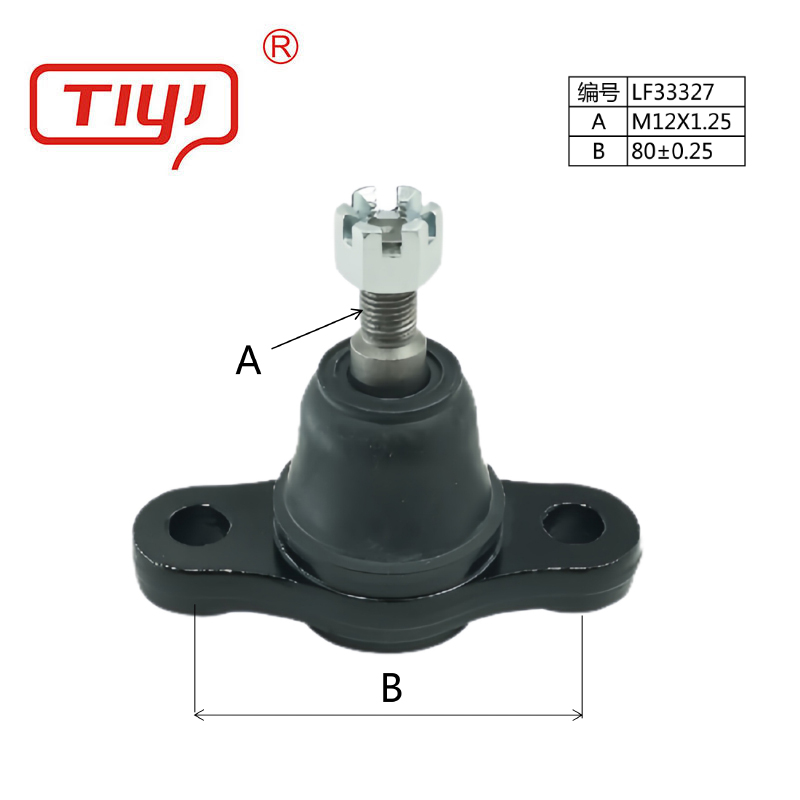 Hyundai Elantra Ball Joint 51760-0Q000Iron ball joint with OEM references for listed Hyundai Elantra, i30, Kia Ceed and Carens applications; useful when inspecting joints on a shaft-replacement corner.View Product →
A 20-minute driveway check
You can rule the shaft in or out in about 20 minutes with a jack, two stands and a torch, and the test that matters most is play at the joints.
- Chock the rear wheels, lift the front, and lower the car onto stands; never work under a car held only by a jack.
- With the transmission in neutral, grip the shaft near each joint and twist. More than roughly 1 mm of rotational play at a U-joint or CV joint means replacement.
- Push and pull the shaft along its axis. Visible in-and-out movement at the inner joint points to a worn tripod or slip yoke.
- Inspect both boots. Cracks, a missing clamp or grease spray on nearby metal justify a rebuild or replacement even if the joint is still quiet.
- Spin each wheel by hand and listen. A rumble that follows wheel speed is more likely a bearing than a shaft.
- On two-piece shafts, check the center support bearing; a sagging rubber mount leaves a shiny rub mark on the tube.
- Road test on smooth asphalt and note the exact speed where vibration starts, then repeat in neutral to separate engine from driveline.
While the car is up, spend two minutes on the other side of the equation: rock each front wheel at 12 and 6 o'clock, then at 3 and 9, and shake the stabilizer links by hand. Loose links knock over bumps and are frequently replaced alongside a shaft because the labor overlaps. A look through the car suspension components listing shows how many of those small parts share the same access point.
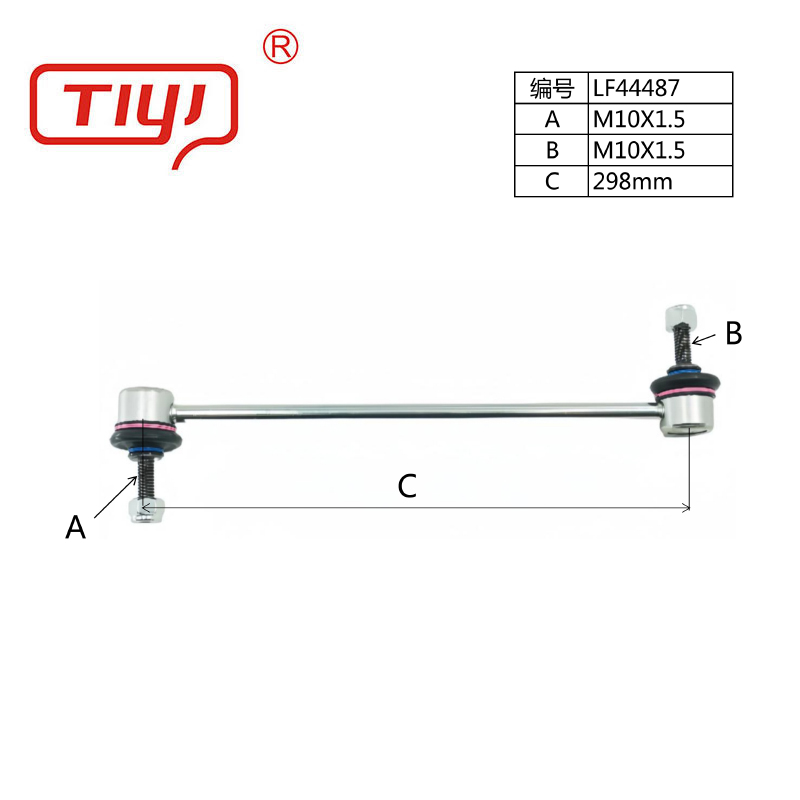 Front Stabilizer Link for Mazda, Ford, VolvoIron front stabilizer link with M10 threads and 298 mm center distance; worth checking alongside suspension or shaft work on listed vehicles.View Product →
Buying a replacement: what separates a good part from a cheap one
Fitment and joint quality decide how long a replacement lasts, and both can be checked before you pay.
| What to check | Why it matters | Acceptable standard |
|---|---|---|
| OEM cross-reference and spline count | Wrong length or spline count ruins fitment and alignment | Match the OEM number on the original part, not just the model year |
| Joint play out of the box | Any play is pre-wear | Zero detectable play, smooth rotation through the full range |
| Boot material and clamp type | Most shaft failures begin at a torn boot | Neoprene or thermoplastic boot, stainless clamp, no grease weep |
| Balance of the assembly | Imbalance recreates the vibration you set out to fix | Balanced as a complete unit, weights welded rather than clipped |
| Warranty and lot traceability | Shows who stands behind the part after the sale | Written term plus a batch or lot code on the box |
The same discipline applies to the surrounding chassis parts that get replaced at the same time. Tianyu has manufactured steering and suspension components since 1998, operates two plants totaling 60,000 m², and develops around 700 new part numbers a year. Ball joints are cycle-tested to 1 million load cycles and bushings to 500,000 simulated rough-road cycles, with a stated return rate below 0.4%. The standard warranty is 2 years or 100,000 km, stock runs above 2 million pieces, minimum order is one carton, and normal lead time is 7–10 days, which suits a workshop that needs one corner rather than a container.
Frequently asked questions
Can I drive with a bad drive shaft?
Short, gentle trips are usually tolerable, but not with a heavy clunk or a vibration that shakes the floor. A front CV axle that fails completely leaves the car immobile, and a rear propshaft that lets go at highway speed can damage the floor, brake lines and fuel lines. Loud clunk plus vibration is a stop-driving condition.
How long should a drive shaft last?
150,000 to 200,000 km is typical for a well-maintained CV axle, and longer for a propshaft on a standard-height vehicle. Lifted suspensions, torn boots and joints run without grease shorten that considerably.
Does a bad drive shaft cause steering problems?
Not directly. A worn outer CV joint can make the wheel feel vague during turns, but pull, wander and an off-center steering wheel almost always come from the steering side, such as tie rod ends, ball joints or a worn rack.
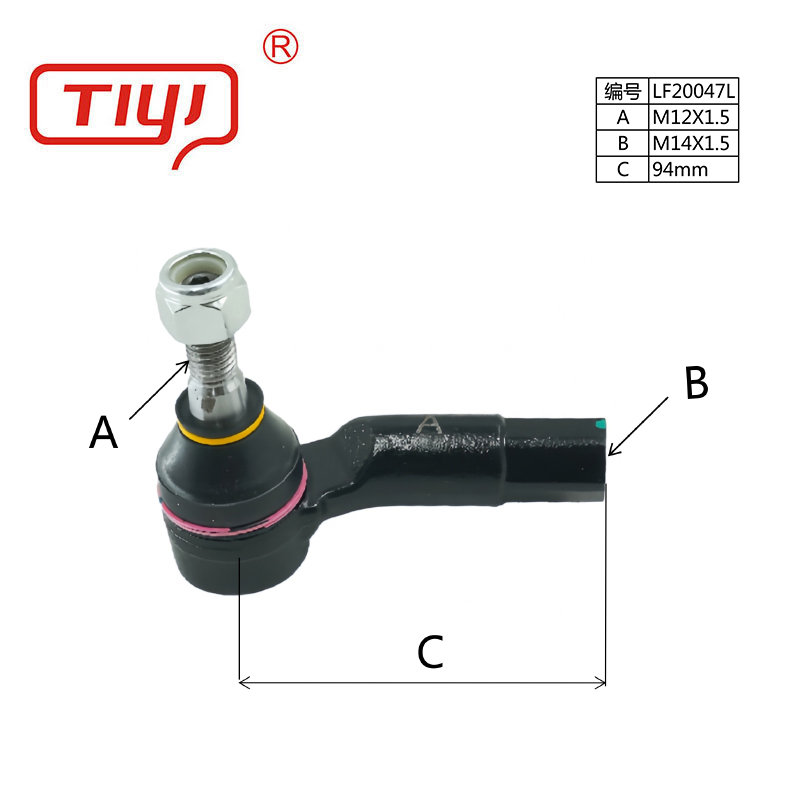 VW Lavida A4 2008-/Tie Rod End/OEM:1J0422811BBall shell thread: M14×1.5View Product →
Why does the vibration only appear at certain speeds?
Imbalance and joint play resonate at a specific rotational frequency, so they are strongest in a narrow band and fade above or below it. That repeatability is useful: note the speed, then compare it with the engine rpm to see whether the driveline or the engine is responsible.
Replace or rebuild?
Rebuilding makes sense for a serviceable propshaft with good splines and an undamaged tube. CV axles are normally replaced as an assembly because the joint, cage and shaft are matched at the factory.
Work in order and the guesswork disappears: match the symptom, decide whether it follows speed or bumps, then check for play at the joints before buying anything. A shaft that clicks on turns or throws grease is a straightforward replacement; a clunk over rough ground usually belongs to a stabilizer link, a control arm bushing or a ball joint. Inspecting the whole corner in one pass costs a few extra minutes and saves a second alignment, a second labor charge and a repeat visit.