


 English
 中文简体
 Español
 عربى


Audi air suspension problems almost always announce themselves weeks before they strand a car. One corner sits 20–30 mm low after an overnight park, the compressor runs every time you unlock the doors, or a clunk appears over broken tarmac that no ride-height change explains.
The answer in one line: Audi air suspension is two systems stacked on top of each other — a pneumatic height system (air springs, compressor, valve block, lines, level sensors, control module) and a conventional mechanical suspension underneath it (control arms, ball joints, tie rod ends, stabilizer links, bushings). Pneumatic faults change ride height; mechanical faults create noise, play and vague steering. Misdiagnosing which layer has failed is the most expensive mistake in this job, because both layers sit in the same corner of the car and the symptoms overlap.
The sections below are written from the parts side of the workbench: which component fails first, what a workshop should measure, and how buyers should specify replacements so the second repair is not a repeat of the first.
Content
- What Audi Air Suspension Actually Does
- Symptom-to-Cause: Where to Look First
- Air Springs Take the Blame; Control Arms Do the Work
- Inspection Checklist Before You Order Parts
- Calibration, Torque and Alignment After the Repair
- Repair the Air, or Convert to Coils?
- What Buyers Should Verify in Replacement Chassis Parts
- Frequently Asked Questions
What Audi Air Suspension Actually Does
Audi's air suspension is a closed-loop ride-height system: four air springs replace steel coils, and a control module varies pressure in each bellows to hold a target height at every corner.
Level sensors report ride height to the module, which commands a compressor and valve block to add or bleed air. On a healthy system the compressor fills from empty in well under a minute, the car holds its height for days, and height changes at speed or on rough surfaces are smooth rather than staged. Adaptive damping is often packaged with the air springs, so the strut carries both a bellows and an electronically variable damper; a replacement must match the damping type, not just the fitment.
The layout appears across the larger Audi ranges — A8 (D3 and D4), Q7 (4L and 4M) and the Allroad variants — with detail differences in compressor, valve block and sensor arrangement. That matters at ordering time, because the same model year can carry two different compressor assemblies depending on market and equipment level.
Symptom-to-Cause: Where to Look First
Start with the symptom rather than the part name, because three different failures can produce an identical complaint.
| What the driver notices | Most likely cause | Fastest check |
|---|---|---|
| One corner low after overnight parking | Leaking bellows fold, line joint or valve-block O-ring | Soapy-water spray on the bellows; measure fender height cold and after 12 hours |
| Compressor runs on every start, later shows a height warning | Worn compressor, saturated air dryer, or a leak forcing constant recharge | Watch fill time and duty cycle; run a leak-down test |
| Car rides hard with correct height | Seized damper, lazy level sensor, or a system left uncalibrated after repair | Scan height-control faults; compare sensor voltages side to side |
| Clunk over bumps at low speed | Worn stabilizer link, control arm bushing or upper link ball joint | Load the suspension with wheels supported and feel for play |
| Vague steering and uneven tyre wear | Worn tie rod end, tired control arm bushings, incorrect ride height | Measure height first, then align to the air-suspension spec |
| Height drops only when parked on a slope | Normal behaviour on some systems, or a slow valve-block leak | Re-test on level ground and repeat the 12-hour measurement |
Two habits cut diagnosis time in half. Measure before lifting the car, and look for the cheap leak before condemning the expensive module — a spray bottle finds more faults than a scan tool on this system.
Air Springs Take the Blame; Control Arms Do the Work
On high-mileage cars, most noises blamed on the air suspension actually come from the mechanical layer underneath it.
Audi's five-link front suspension uses four control links plus a tie rod end per side, and the rear multi-link carries a similar count. Each link pivots on a rubber bushing and ends in a ball joint. When a bushing perishes, the arm moves under load instead of pivoting cleanly, so camber and toe change as the car brakes, corners and runs over crests. The result is wander, inner-edge tyre wear and a dull clunk at low speed — none of which a bellows can cause. Air-suspended cars feel it sooner because ride height moves constantly, so a worn joint works through a wider range of angles than it would on a steel-sprung car.
Fitting practice matters as much as the part. Install the arm with new hardware and torque rubber-bushed fasteners at normal ride height, not at full droop, or the bushing preloads and fails early. Our control arm range is built to OE dimensions for that reason: hole centres, ball-joint taper and bushing hardness all have to match, or the alignment will never stay inside spec.
A representative example of how these parts are specified and shipped:
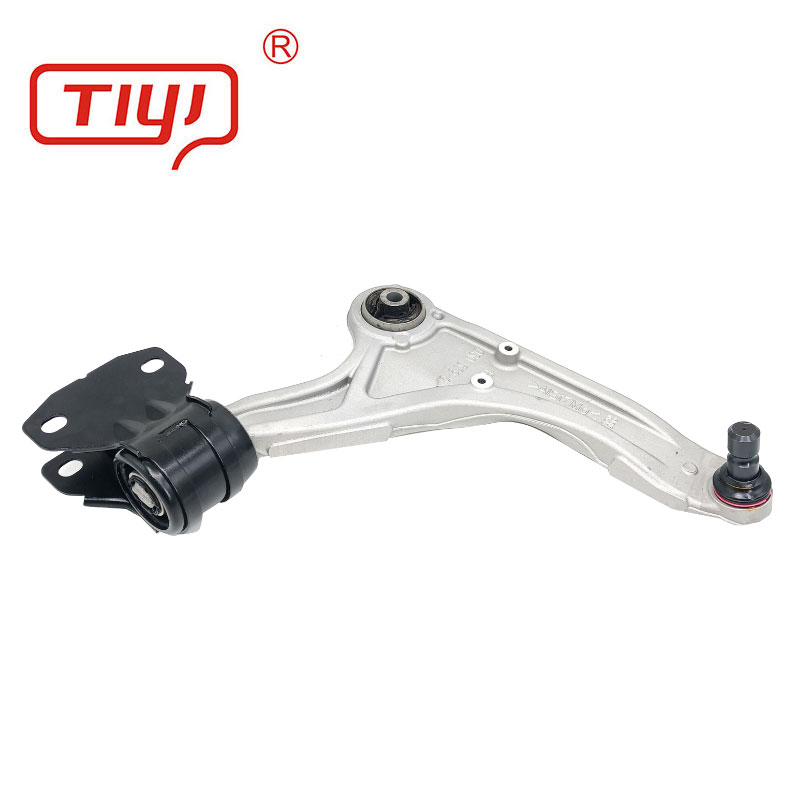 Tianyu LF60473R Lower Control Arm for Ford MondeoAluminum lower control arm for Ford Mondeo 2013–2015 and Lincoln MKZ 2014–, listed with OEM references and MOQ 30 for specification review and inquiry.View Product →
Inspection Checklist Before You Order Parts
Six checks separate a one-time repair from a repeat visit.
- Measure all four corners cold and again after 12 hours; a single-corner drop points to that corner's bellows or line, not the compressor.
- Watch compressor duty cycle. A system that recharges on every start has a leak, and a compressor running past its normal fill time is already wearing.
- Spray soapy water on bellows folds, line joints and the valve block; bubbles beat guesswork every time.
- Load the suspension with the wheels supported and check each ball joint, tie rod end and stabilizer link for play before blaming a strut.
- Match part numbers to the VIN rather than the model year alone, and confirm whether the car carries adaptive damping.
- Ask for the alignment specification for the air-suspended variant — it differs from the steel-sprung version, and aligning at the wrong height wears tyres quickly.
Stabilizer links are the cheapest wear item on that list and the most common source of low-speed clunks, so check them first:
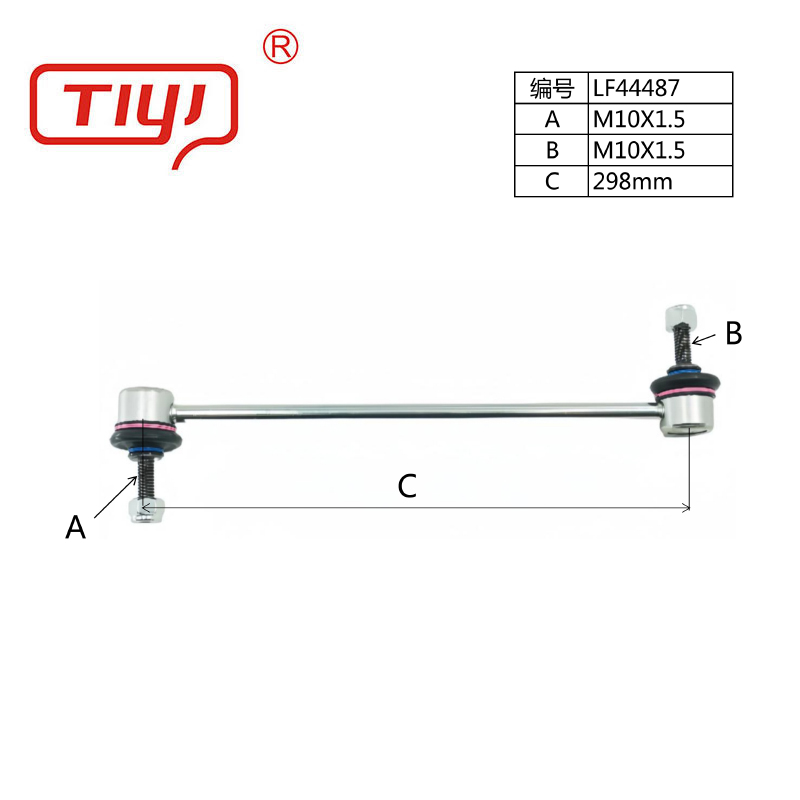 Front Stabilizer Link for Mazda 3, Ford Kuga and VolvoIron front stabilizer link with 298 mm center distance, listed for Mazda 3, Ford Kuga, Lincoln MKC and Volvo XC60; check for low-speed clunks.View Product →
Calibration, Torque and Alignment After the Repair
Every air suspension repair ends with calibration, not with the last bolt.
Replacing a level sensor, air spring or control module leaves the system without a valid height reference, so it needs a basic setting or ride-height calibration with a factory-level diagnostic tool. Skipping that step leaves the car sitting at the wrong height, wearing tyres unevenly and storing codes that look like component failures. Torque rubber-bushed fasteners at design height, align the car with the system at its normal ride height, then confirm compressor duty cycle and inspect the air dryer — a saturated dryer pushes moisture into the valve block and turns a cheap repair into an expensive one.
Repair the Air, or Convert to Coils?
Conversion to coil springs is a legitimate budget decision, but it changes the car rather than restoring it.
- You gain: no compressor or bellows to fail, lower parts cost, simpler fault-finding.
- You lose: self-levelling under load and towing, adjustable height on rough roads, and part of the ride quality the car was engineered around.
- You risk: kits with mismatched spring rates and weak top mounts that sit too high and ruin alignment.
- You show: a converted car is obvious to a buyer who knows the model, which affects resale.
For an owner keeping the car another three years, repairing the air side and refreshing the worn mechanical parts is usually the cheaper route overall, because the next failure is far more likely to be a control arm or a link than another air spring.
What Buyers Should Verify in Replacement Chassis Parts
For distributors and workshops, the specification sheet matters more than the price list, because a chassis part that fails at 20,000 km costs far more than the few dollars saved at purchase.
Confirm that the manufacturer works to OE dimensions, tests to a stated cycle count, and backs the part with a written warranty. Our own benchmarks, for reference: ball joints run to 1,000,000 load cycles without failure, suspension bushings survive 500,000 simulated rough-road cycles, and the return rate across the range stays below 0.4%. Production runs across two plants totalling 60,000 m², with capacity to develop around 700 new part numbers a year, stock above two million pieces, a one-carton minimum order and a 7–10 day lead time — that combination is what makes small mixed orders practical for a workshop or a regional distributor. Coverage detail sits on our OEM suspension parts page, and every part carries a two-year or 100,000 km warranty.
A sample from the ball joint line, tested to the cycle count above:
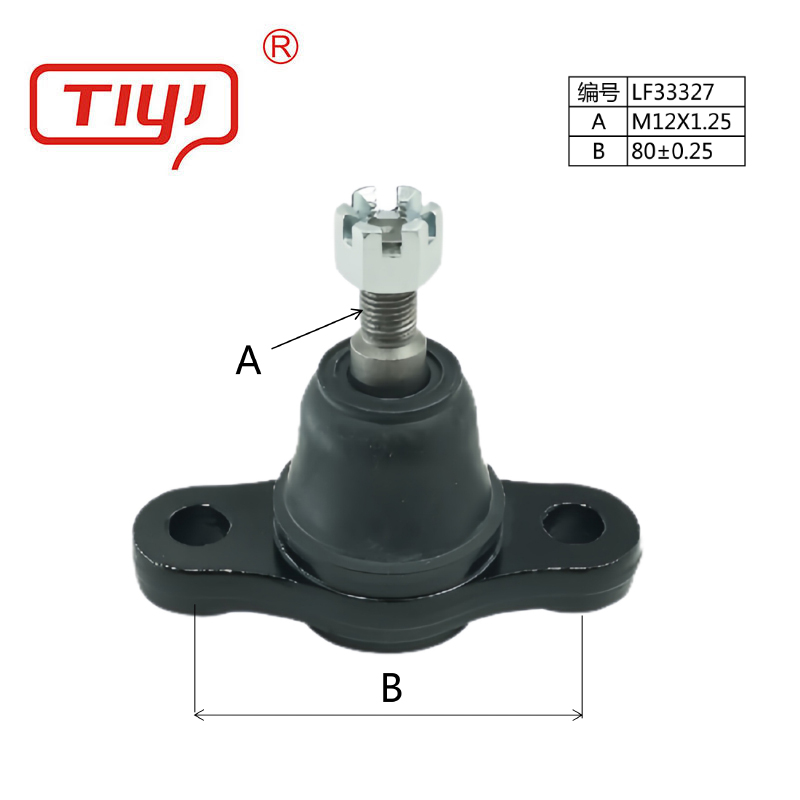 Tianyu LF33327 Ball Joint for Hyundai Elantra and i30Ball joint for Hyundai Elantra 2000–2007 and i30, with OEM 51760-0Q000; review thread size and listed Kia fitments as a ball-joint wear sample.View Product →
Frequently Asked Questions
How long do Audi air springs usually last?
There is no fixed service interval, but failures cluster between roughly 100,000 and 180,000 km, and rubber age counts as much as mileage: a ten-year-old car with 80,000 km can leak before a five-year-old car with 150,000 km. Hot, dusty or heavily salted climates shorten that window.
Can I drive with a leaking air spring?
Usually yes, for a short distance and at low speed, but the compressor runs constantly to compensate and can burn out, which turns one repair into two. Avoid loading the car and book the repair quickly.
Should both sides be replaced at once?
When the parts share the same age and mileage, yes. Matching sides keeps the heights even and makes the alignment result predictable.
Are control arms different on air-suspended cars?
Often the arms and joints are shared with steel-sprung variants, but the alignment specification and the load pattern differ because ride height keeps changing. Order to the VIN, and always align at design height.
Does a coil conversion still need an alignment?
Yes, and it needs a height check too. Conversions change static ride height, which shifts camber and toe, so an alignment straight afterwards protects the tyres and the new springs.