


 English
 中文简体
 Español
 عربى


Camber bushings are alignment bushings that set or limit camber at a suspension pivot. They are used when the original adjustment range is too small, when a lowered or lifted vehicle needs correction, or when a worn bushing has allowed the arm to move out of position. The practical answer is straightforward: confirm the bore and arm first, choose a material that matches the use case, and plan a four-wheel alignment after installation.
If you are diagnosing uneven tire wear, do not order a camber bushing by vehicle name alone. Measure the mounting bore, check the control arm and ball joint, and record the current alignment readings. A bushing can correct a small, repeatable camber error; it cannot correct a bent arm, a collapsed strut mount, or a worn ball joint.
Content
What camber bushings do
A camber bushing changes or locks the camber angle at a suspension pivot, so it directly affects the tire contact patch and shoulder wear.
Camber is the inward or outward tilt of the wheel viewed from the front. Too much negative camber loads the inner shoulder; too much positive camber loads the outer shoulder. An OEM-style bushing usually holds a fixed position, while an offset or adjustable camber bushing moves the pivot point to bring the alignment reading back into range.
- Restores adjustment range: useful after ride-height changes, collision repair, or worn suspension settlement.
- Corrects repeatable camber drift: appropriate when the alignment machine shows the same error after the arm is loaded and unloaded.
- Improves tire contact: helps even out shoulder temperatures on street or track use, provided the rest of the suspension is sound.
- Locks a target setting: some designs are fixed-offset bushings rather than continuously adjustable parts.
A camber bushing is not a substitute for a proper alignment. It changes the mechanical range available to the alignment technician; the final setting still depends on toe, caster, ride height, and loaded suspension geometry.
Types and materials: what changes handling and service life
The right material depends on adjustment frequency, road conditions, and whether the bushing must absorb noise or hold a firm position under load.
| Type | What it does | Best for | Watch-outs |
|---|---|---|---|
| OEM-style rubber | Holds a fixed position with bonded rubber isolation | Stock ride comfort and normal repair work | Limited adjustment range; rubber can soften with age and oil exposure |
| Offset or eccentric rubber | Moves the pivot point to change camber | Small corrections where original hardware is retained | Installation orientation must be exact; a wrong index can worsen the reading |
| Polyurethane | Firmer bushing with controlled deflection | Performance street, occasional track use, and repeatable alignment | More road noise and vibration; durometer and fit quality vary widely |
| Spherical or bearing-type | Low deflection and free articulation | Competition or heavily loaded suspension | Harsh on the street; requires inspection and seals to resist contamination |
Ask for the durometer, sleeve material, and bore tolerance. A 75 Shore A polyurethane bushing and a 90 Shore A part may look similar, but they feel different on the road and load the mounting points differently. For a daily driver, a firmer bushing should be selected only when the alignment benefit is clear and the owner accepts extra NVH.
Symptoms and diagnosis before buying
Uneven inner or outer shoulder wear is the most reliable sign that camber is outside the intended range.
Start with tire pressures, ride height, and a visual check of the arm, ball joint, strut mount, and subframe. Worn control arm bushings can also change geometry under load, so a bushing that looks intact may still be moving more than it should.
- Inner-edge wear: often linked to excessive negative camber or toe wear that mimics camber wear.
- Outer-edge wear: often linked to positive camber, especially after a lift or worn suspension components.
- Pull or off-center steering: can come from camber mismatch, caster difference, or tire conicity.
- Alignment cannot reach spec: a common trigger for installing an offset or adjustable camber bushing.
- Clunk over bumps: may indicate a worn bushing, loose sleeve, or damaged arm bore rather than an alignment problem.
Record the before-and-after alignment readings. If the camber changes when the vehicle is lowered onto the alignment plates, inspect the arm and bushing seats before assuming the bushing is the fix.
Fitment and specification checklist
Fitment is a dimensional and load problem, not a catalogue-name problem.
| Check | Why it matters | Acceptance criteria |
|---|---|---|
| Mounting bore diameter | Controls press fit and sleeve support | Measure with a caliper and compare to the supplier drawing; reject an oval bore |
| Bushing width and sleeve length | Affects arm clamping and alignment stability | Confirm the sleeve protrudes correctly and the arm can be torqued without crushing the bushing |
| Adjustment range | Determines whether the target camber is reachable | Check the stated offset or range against the current alignment reading, leaving a small margin |
| Torque procedure | Prevents preload and premature failure | Torque at normal ride height unless the manufacturer specifies otherwise |
| Material and finish | Affects noise, corrosion, and service life | Confirm rubber or polyurethane grade, sleeve coating, and resistance to road salt |
For a press-fit part, a few tenths of a millimeter matter. If the bore is out of round, the arm is bent, or the old sleeve has seized, replacement of the arm assembly may be more reliable than forcing a new bushing into a damaged housing.
Installation and alignment risks
Most camber bushing failures come from installation and torque procedure, not from the bushing material itself.
- Mark the original bushing orientation and record the alignment readings before disassembly.
- Support the control arm at ride height and avoid loading the bushing through the sleeve.
- Press the bushing with the correct mandrel; hammering distorts the bore and damages the sleeve.
- Use only lubricants compatible with the bushing material, and keep grease away from rubber-bonded surfaces unless specified.
- Torque suspension fasteners at normal ride height so the bushing is not preloaded at full droop.
- Complete a four-wheel alignment and recheck camber, caster, toe, and thrust angle.
Skip the alignment and the vehicle may feel better for a short distance, then wear a tire shoulder or develop a pull as the suspension settles. A camber bushing should be treated as one part of a geometry correction, not a standalone repair.
When a camber bushing is not the whole fix
If the control arm bore is oval, the arm is bent, or the sleeve has seized, pressing in a new camber bushing is false economy.
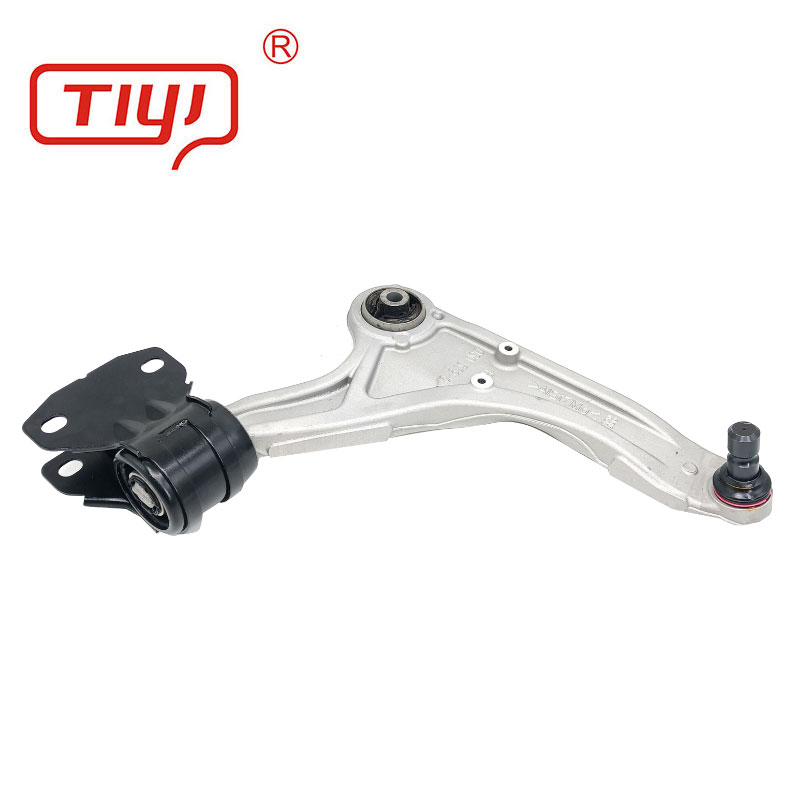 Ford Mondeo 2013-2015/LOWER CONTROL ARM/OEM:DG9C3A053ANEAcceptable product customizationView Product →
A complete lower control arm assembly restores the mounting geometry and removes the risk of a poor press fit. For a 2013–2015 mid-size sedan application, the lower control arm is listed by side; confirm left or right before ordering. If the original arm is straight and the bore is round, a bushing replacement remains the lower-cost route.
Buying criteria for camber bushings
Buy on dimensional control, material consistency, and documentation—not on a low unit price alone.
- Drawing and tolerance: request bore diameter, sleeve length, width, and adjustment range in writing.
- Material data: confirm rubber grade or polyurethane durometer, plus any bonded or bearing construction details.
- Batch traceability: for workshop or distribution orders, ask how batches are marked and controlled.
- Torque and installation notes: a supplier that cannot state the torque procedure is a service risk.
- Corrosion protection: check sleeve coating and hardware finish for the market where the vehicle operates.
- Stock and lead time: alignment work is often urgent; small-order availability matters for repair shops.
For B2B buyers, compare the total cost of a repeat alignment against the unit price. A cheap bushing that cannot hold torque or deliver the stated range creates comeback labor. Browse our suspension bushings range to compare construction options, or ask for a drawing before committing to a batch.
FAQ
Are camber bushings legal for road use?
Legality depends on the jurisdiction and how far the alignment is moved from the manufacturer specification. Check local inspection rules and insurance conditions before fitting an adjustable bushing that changes the original range.
Can I install camber bushings without an alignment?
No. Installation changes the pivot position, and the final camber and toe must be measured under load. Driving without an alignment can create rapid tire wear even if the steering feels normal.
Do camber bushings fix uneven tire wear?
Only when the wear is caused by camber and the rest of the suspension is sound. Toe error, worn ball joints, low tire pressure, and bent arms can produce similar wear patterns.
Should I replace both sides at once?
Inspect both sides. If the vehicle has high mileage or one bushing has failed from age, replacing as a pair helps keep handling balance predictable and avoids a second alignment shortly afterward.
Polyurethane or rubber for a daily driver?
Rubber is usually the better default for comfort and noise. Polyurethane can be appropriate when the owner wants firmer location and accepts extra vibration, but the durometer and fit quality must be suitable for street use.
How long do camber bushings last?
Service life depends on material, load, road conditions, and installation quality. Inspect them at every alignment and during suspension service; a bushing that has softened, cracked, or shifted should be replaced before it damages a tire.
Final takeaway: a camber bushing is a geometry part, not a universal cure for tire wear. Measure the bore, confirm the arm and related joints, choose a material that matches the driving use, and budget for a proper alignment. That sequence protects handling, tire life, and the reputation of the repair.