

 English
 中文简体
 Español
 عربى


A worn stabilizer link announces itself with a short, metallic clunk over low-speed bumps, followed by more body roll in turns, a vaguer steering center, and uneven tire wear. The stabilizer link, also called a sway bar link or anti-roll bar link, is a short rod with a ball joint or bushing at each end that connects the stabilizer bar to the lower control arm or strut. It has to pull both sides of the suspension together in a corner while still letting each wheel move independently over a bump.
Its failure is rarely dramatic. The joint inside wears from a normal clearance of around 0.2 mm to more than 1.5 mm over tens of thousands of kilometers, and the noise, wander, and vibration appear gradually along the way. The sections below explain each signal, how to confirm the diagnosis in a few minutes, and how to avoid replacing the wrong part.
Content
- What a Stabilizer Link Actually Does
- Seven Common Signs of a Bad Stabilizer Link
- 1. Metallic Clunking Over Low-Speed Bumps
- 2. More Body Roll in Corners and Lane Changes
- 3. Vague Steering Center or a Slight Pull
- 4. Uneven or Cupped Tire Wear
- 5. Play You Can Feel During a Static Check
- 6. A Split Boot, Grease Loss, or Rust on the Ball Stud
- 7. Symptoms That Appear Suddenly After a Curb Strike
- A Sixty-Second Self-Check Without a Lift
- Stabilizer Link, Ball Joint, or Tie Rod End?
- What Happens If You Keep Driving on a Bad Link
- What to Check Before You Buy a Replacement
- Frequently Asked Questions
What a Stabilizer Link Actually Does
A stabilizer link transfers load between the stabilizer bar and the suspension, so when it loosens up, body roll increases and road impacts reach the cabin more directly.
Most front suspensions on passenger cars are MacPherson struts or multi-link setups, where the two lower control arms can move up and down independently. The stabilizer bar spans the vehicle, and each end connects through a link to the suspension. Driving straight, both wheels travel together, the bar simply rotates, and the links carry almost no load. In a corner, the inner suspension extends while the outer compresses, the bar twists, and part of the outer load is shared with the inner side, which reduces roll.
The link joint is the pivot in that motion. It sees repeated tension, compression, torsion, plus road salt, grit, and water. Once either end develops play, the knock travels through the subframe and into the cabin, which is why the sound seems louder than the part deserves.
Seven Common Signs of a Bad Stabilizer Link
Ranked by how often they show up first, the seven signs are: a clunk over bumps, increased body roll, vague steering, uneven tire wear, detectable play during a static check, a torn boot with grease loss, and a sudden worsening after a curb strike or pothole.
1. Metallic Clunking Over Low-Speed Bumps
This is the earliest and most common sign, and it is usually loudest between roughly 20 and 40 km/h.
Once the joint clearance grows past about a millimeter, the ball stud starts shifting inside its socket as the suspension cycles, producing a short, sharp tap. The sound comes from near the wheel rather than from behind the steering wheel. It is often worst on a cold start and quiets down slightly once the grease warms up, which is why many drivers assume the problem is minor.
2. More Body Roll in Corners and Lane Changes
When both links are close to the end of their life, the stabilizer bar can no longer transfer load properly and body roll becomes noticeably larger.
A practical test is to take a familiar freeway ramp at the speed you normally use and compare how much the body leans. If the lean is greater than before, or the car rocks an extra time as it settles, the links deserve a look. When only one side is worn, the difference between left and right corners is often easier to feel than the noise is to hear.
3. Vague Steering Center or a Slight Pull
Play in the link reduces steering precision and shows up as a dead band around the straight-ahead position.
There is a useful distinction here. A dead band caused by a stabilizer link almost always comes with clunking over bumps, while a dead band caused by a worn inner tie rod end can be felt even with the car parked. A pull that only appears on one type of road surface is more likely a tire or alignment issue than a link problem.
4. Uneven or Cupped Tire Wear
The link itself barely changes wheel alignment, but the suspension play it introduces lets alignment shift while driving, which accelerates tire wear.
The typical pattern is a sawtooth or cupped wear band on the inner or outer shoulder of a front tire, often with a tread depth difference of one to two millimeters across the tread. If a fairly new tire shows this pattern, checking the links and ball joints is worth doing alongside a four-wheel alignment.
5. Play You Can Feel During a Static Check
With the car lifted and the suspension hanging free, grip the link at both ends and rock it in every direction; more than about one millimeter of movement means the joint is worn.
This check is more reliable than listening for noise. A healthy ball joint feels essentially solid when it is unloaded.
6. A Split Boot, Grease Loss, or Rust on the Ball Stud
Once a boot splits, the grease washes out within a few washes or a rainy season, and the joint wears much faster over the next few thousand kilometers.
Use a flashlight on both ends of the link. A cracked rubber boot, grease weeping out, or visible rust on the ball stud is enough reason to replace the part before noise even starts.
7. Symptoms That Appear Suddenly After a Curb Strike
The link is one of the lighter parts of the suspension, so a single hard impact can turn a slightly worn joint into a clearly loose one.
If a curb or a deep pothole is followed by new or noticeably louder chassis noise, check the links and the stabilizer bar bushings before driving several thousand more kilometers on them.
| Symptom | Most likely component | Urgency |
|---|---|---|
| One-sided clunk over low-speed bumps | Stabilizer link ball joint clearance | Medium; drivable, but wear accelerates |
| Clearly larger body roll in corners | Both links worn or already broken | High; replace soon |
| Steering dead band plus bump noise | Link play, possibly combined with tie rod wear | Medium to high; needs a lift inspection |
| Sawtooth wear on the front shoulder | Alignment drift from suspension play | Medium; realign after replacement |
| Split boot or rusted ball stud | Early link or ball joint failure | Medium; do not wait for noise |
A Sixty-Second Self-Check Without a Lift
If you can park on level ground, set the handbrake, and chock the wheels, three steps cover most of the diagnosis.
- Bounce the corner. Push hard on the front corner and release. Listen for a short tap and watch whether the body settles in more than two rebounds.
- Lift one side. Raise the front wheel until it is off the ground and the suspension hangs free, then grip the link at both ends and rock it. Feel for clearance.
- Look closely. Use a flashlight on both boots and ball studs. Check for cracks, grease seepage, and rust.
If any of these steps feels abnormal, you have narrowed the fault to the link area. To separate the left link from the right, a pry bar on a lift, applying roughly 50 to 100 N, will show whether the ball stud shifts inside its socket.
Stabilizer Link, Ball Joint, or Tie Rod End?
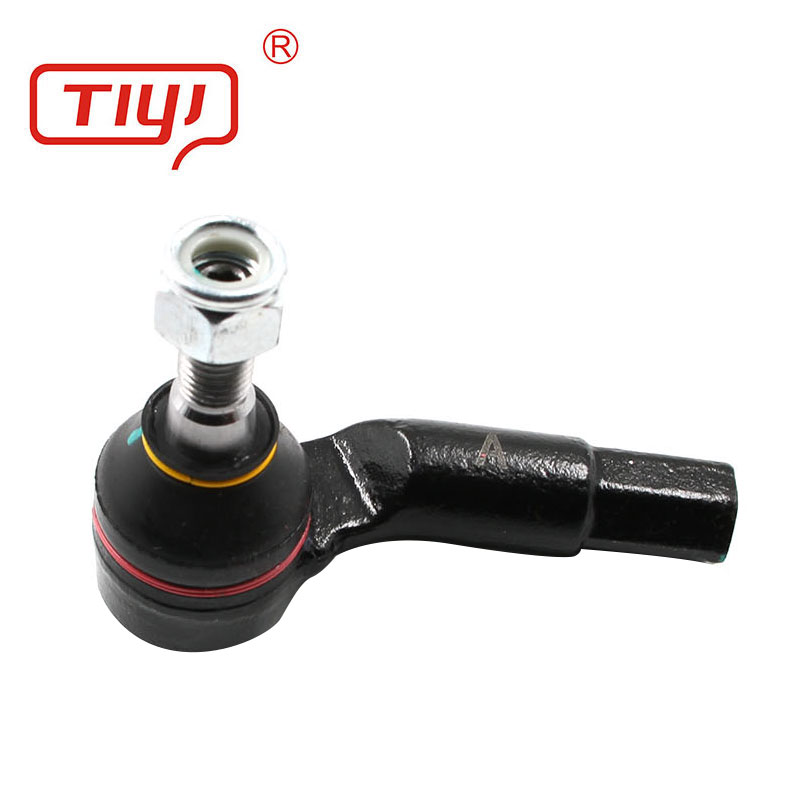
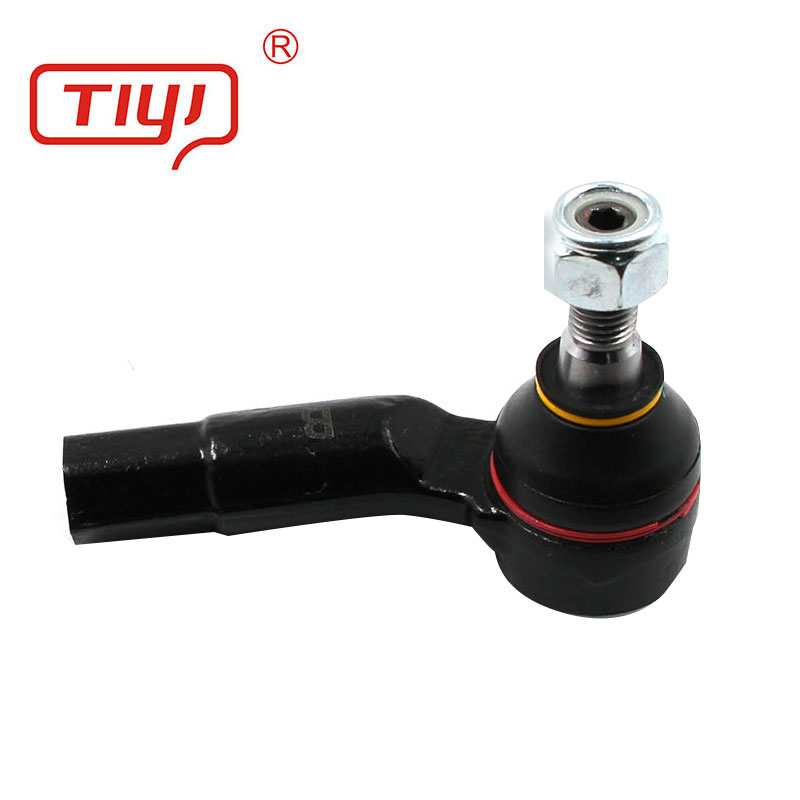
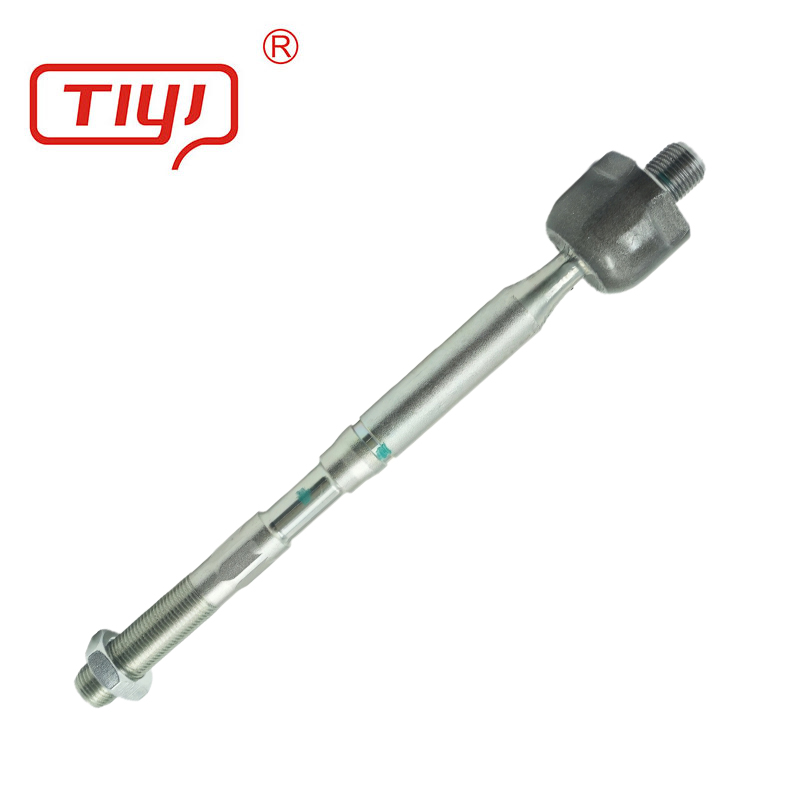
The three parts are easy to confuse, but the logic is fairly clean: link problems are loudest over bumps, ball joint problems show up under cornering and load, and tie rod problems show up as increased steering free play.
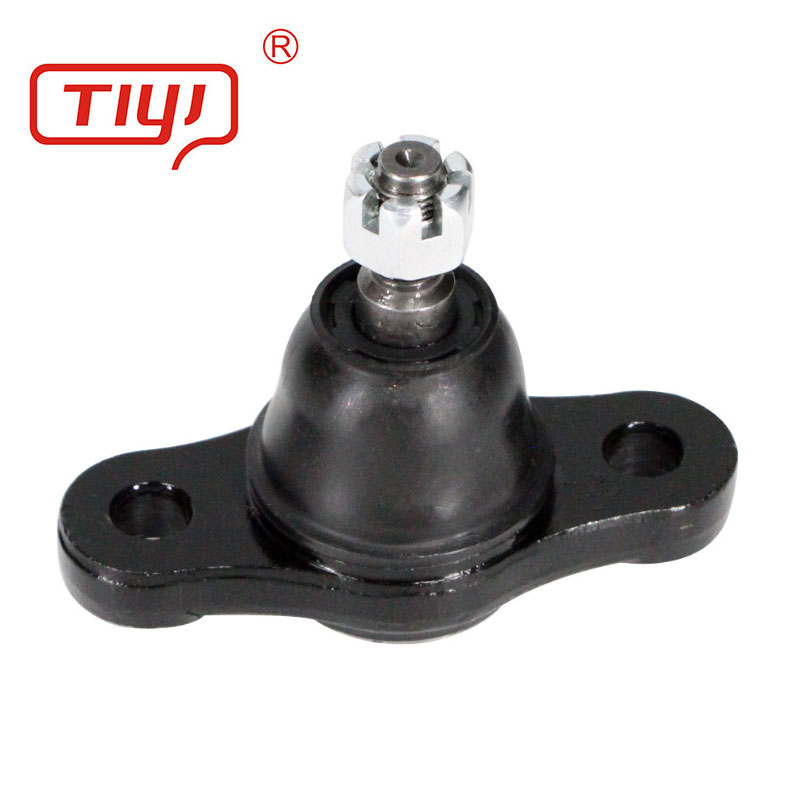
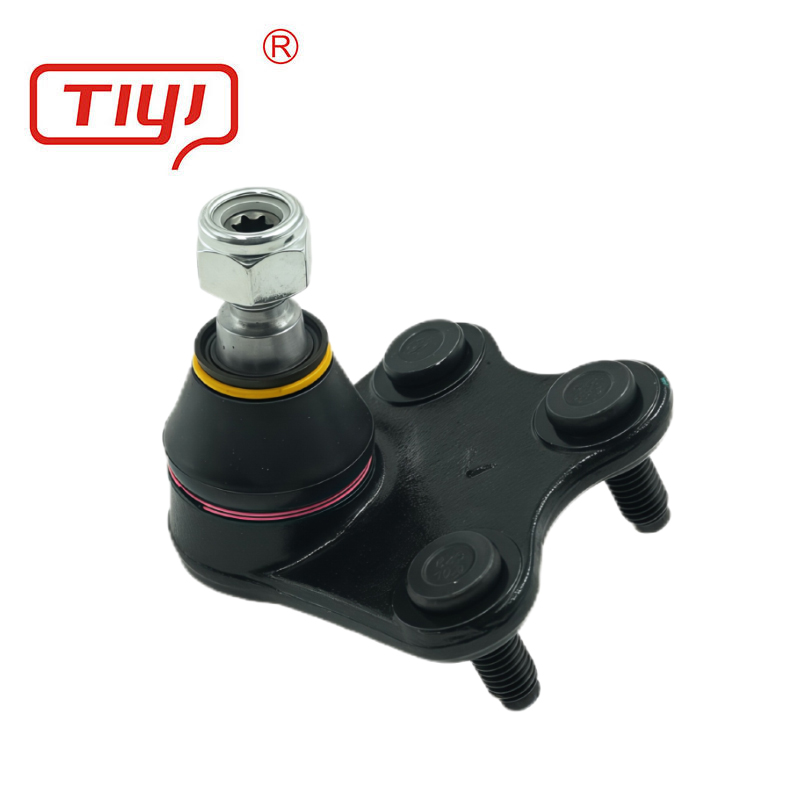
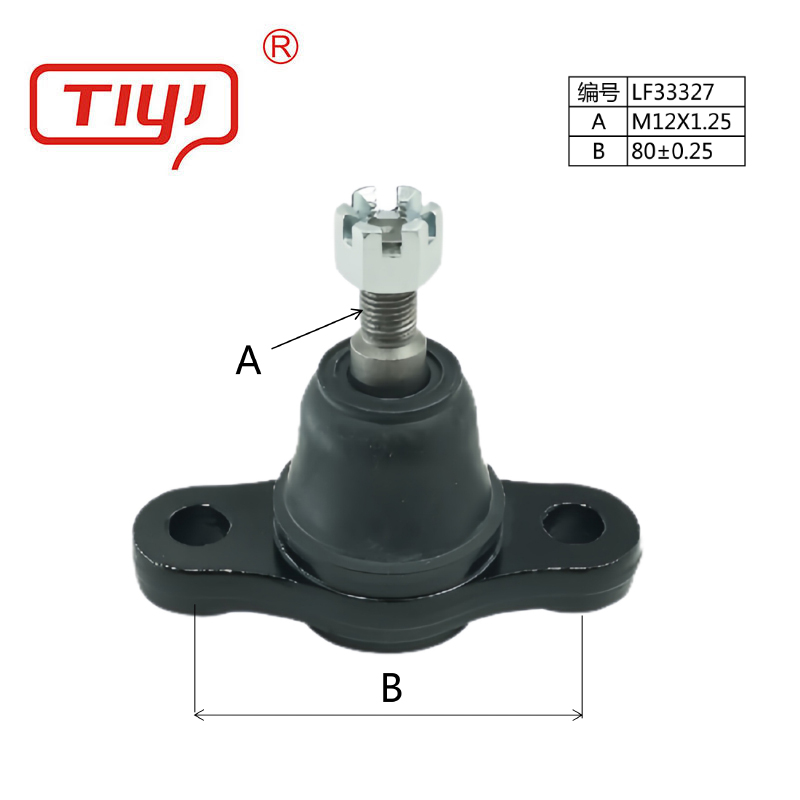 Hyundai Elantra i30 Kia CEED Carens Ball JointIron ball joint with M12x1.25 thread and OEM 51760-0Q000, listed for Hyundai Elantra, i30, Kia CEED, and Carens.View Product →
When the Noise Appears
A stabilizer link knocks while driving straight over broken pavement; in a corner it may be masked by body and tire noise.
A worn ball joint tends to make noise in turns, on inclines, or whenever one wheel carries extra load, because that is when the joint sees its highest stress. Wear in an inner or outer tie rod end usually shows up as a larger dead band at the steering wheel rather than as chassis noise.
Which Direction the Play Moves
Link joints usually show axial and radial play, while ball joints show more vertical play and let the tire wobble.
| Part | Typical sound or feel | Main effect on driving | Replacement difficulty |
|---|---|---|---|
| Stabilizer link | One-sided clunk at low speed; over 1 mm of play when rocked by hand | More body roll, less precise steering center | Low; usually one or two wrenches |
| Ball joint | Knock in turns or under single-wheel load; clear vertical play | Tire wobble, unstable steering, possible separation in extreme cases | Medium; often needs a dedicated puller |
| Tie rod end | Larger steering free play, felt even when parked | Slower steering response, possible toe change | Medium; alignment is required afterward |
What Happens If You Keep Driving on a Bad Link
Delaying the repair rarely causes an immediate loss of control, but it shifts impact loads onto the stabilizer bar, control arm bushings, and strut mounts, which grows the repair bill.
Every millimeter of extra clearance sends a more direct impact into the bar and its bushings. The usual knock-on damage includes:
- Stabilizer bar bushings wear oval, adding a deeper, duller thud to the original clunk.
- Control arm bushings age faster, so alignment drifts while you drive.
- Front tire shoulders cup, and a single tire can lose ten to twenty thousand kilometers of service life.
- In extreme cases the link separates from its ball stud, and the bar starts striking the chassis or lower arm, making the noise and damage much worse.
The decision rule is simple: repeatable clunking plus more than a millimeter of play is enough to justify replacement, without waiting for a visible break.
What to Check Before You Buy a Replacement
The deciding factors are not the sticker price but the joint sealing method, the boot material, and the corrosion protection, because those three determine how long the new part lasts.
- Joint sealing type. A sealed, maintenance-free joint installs easily and costs less, while a greaseable design with a fitting suits dusty or off-road use, provided you actually top it up.
- Ball stud material and heat treatment. Alloy steel such as 40Cr with quenching or surface hardening is common; surface hardness is typically expected to reach about HRC 50, and softer studs tend to dent after tens of thousands of kilometers.
- Boot material. Neoprene or hydrogenated nitrile rubber resists oil and ozone better than plain natural rubber, especially in hot climates and road-salt conditions.
- Corrosion protection. Salt spray endurance of the rod and housing is a useful benchmark, with common grades at roughly 240 and 480 hours; the longer figure suits coastal and high-latitude markets.
- Dimensional tolerances. The ball stud taper and thread must match the original specification, since poor taper contact leads to torque loss and recurring noise.
If you are replacing both links, buy them as a matched pair from the same batch so the left and right sides behave the same way. If the job expands to other suspension parts, ordering a complete suspension repair kit often saves time compared with buying each piece separately. You can also check a stabilizer link fitment list against your model year before ordering.
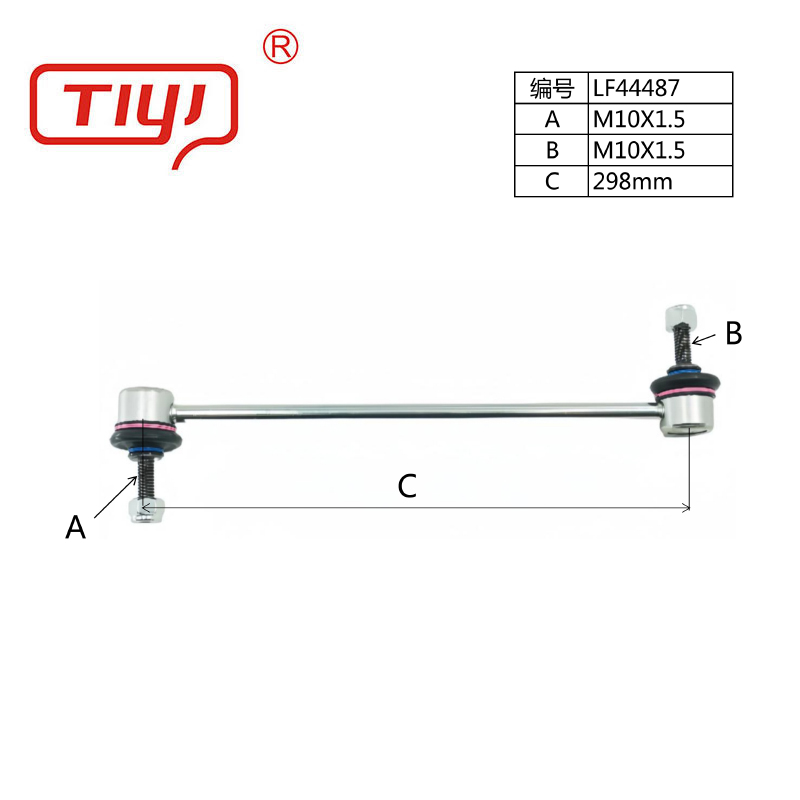 Front Stabilizer Link for Mazda 3, Ford, VolvoIron stabilizer link with M10x1.5 threads, 298 mm center distance, and OEM AV613B438BA, listed for Mazda 3, Ford Kuga, Lincoln MKC, and Volvo XC60.View Product →
Frequently Asked Questions
Can I keep driving with a bad stabilizer link?
Yes for a short distance, but replace it soon, because ongoing play accelerates wear in the stabilizer bar bushings and control arm bushings.
If the joint has only slight clearance and the noise appears just at low speed, a few hundred kilometers is unlikely to cause harm. If body roll has clearly increased or the chassis clunks continuously, schedule the repair first so the impact loads do not move up into more expensive parts.
Do stabilizer links have to be replaced in pairs?
Not strictly, but replacing them as a pair is the safer choice.
Both sides usually see the same mileage and environment, so when one shows clear wear, the other is typically near the end of its life. Replacing only one often means a second repair a few thousand kilometers later.
Do I need a wheel alignment after replacing a link?
Replacing a stabilizer link alone does not change alignment settings, so an alignment is normally not required; if control arms, tie rod ends, or ball joints were also replaced, it is mandatory.
What does a bad link actually sound like?
Most often it is a short metallic tap, clearest at low speed over manhole covers, expansion joints, or speed bumps, and it comes from near the wheel rather than from behind the steering wheel.
Why is there still a noise after fitting new links?
The three usual causes are worn stabilizer bar bushings, clearance in the ball joint or tie rod ends, or fasteners that were not tightened to specification.
Start by confirming the torque on both link nuts, then work through the bar bushings, ball joints, and tie rod ends in that order.
Diagnosing a bad stabilizer link comes down to three checks: listen for a one-sided clunk over low-speed bumps, feel for more than a millimeter of play with the suspension unloaded, and inspect the boots and ball studs for cracks, grease loss, and rust. If two of the three point the same way, the link is the part to replace. The link itself is inexpensive, so the real cost of waiting is the stabilizer bar bushings, control arms, and tires that wear out alongside it. Catching the early signals is one of the best-value maintenance decisions on the whole chassis.