

 English
 中文简体
中文简体
 Español
 عربى
عربى


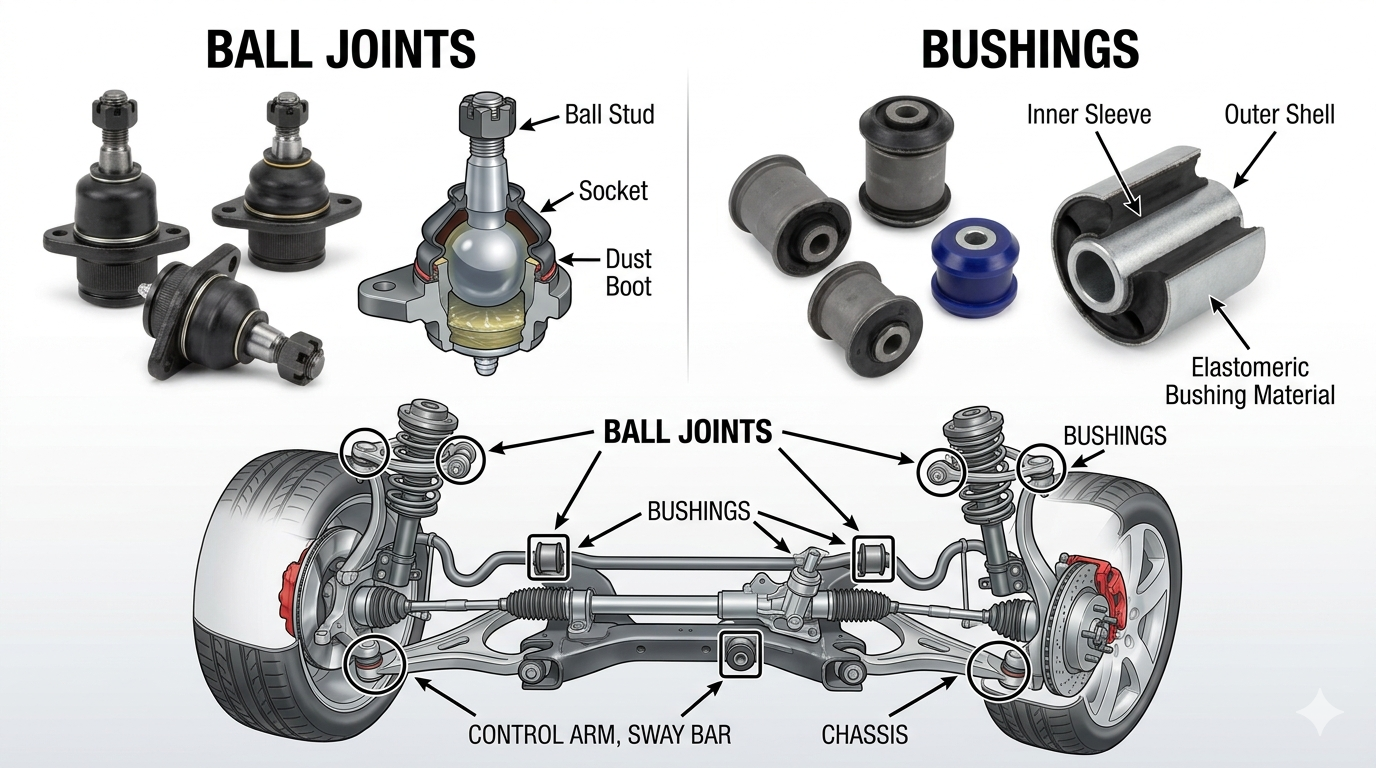
Ball joints and bushings are two of the most critical wear components in a vehicle's suspension and steering system. Ball joints are spherical pivot points that connect the wheel hub to the suspension control arms, allowing both rotational and angular movement. Bushings are cylindrical rubber or polyurethane sleeves that cushion and isolate metal-to-metal contact at suspension pivot points. Both need replacement when they show measurable play, cracking, or noise — typically every 70,000 to 150,000 miles depending on driving conditions, material quality, and maintenance frequency. Ignoring worn ball joints and bushings is one of the leading causes of premature tire wear, alignment failure, and loss of steering control.
Content
- What Are Ball Joints? Function, Design, and Location
- What Are Bushings? Function, Materials, and Types
- Ball Joints vs. Bushings: Core Differences at a Glance
- Warning Signs of Worn Ball Joints and Bushings
- How to Inspect Ball Joints and Bushings: A Step-by-Step Guide
- Rubber vs. Polyurethane Bushings: Detailed Comparison
- Ball Joint and Bushing Replacement: Cost, Labor, and What to Expect
- Factors That Accelerate Ball Joint and Bushing Wear
- The Consequence of Ignoring Failed Ball Joints: A Safety Perspective
- Frequently Asked Questions About Ball Joints and Bushings
- Conclusion: Prioritizing Ball Joint and Bushing Health Is Non-Negotiable
What Are Ball Joints? Function, Design, and Location
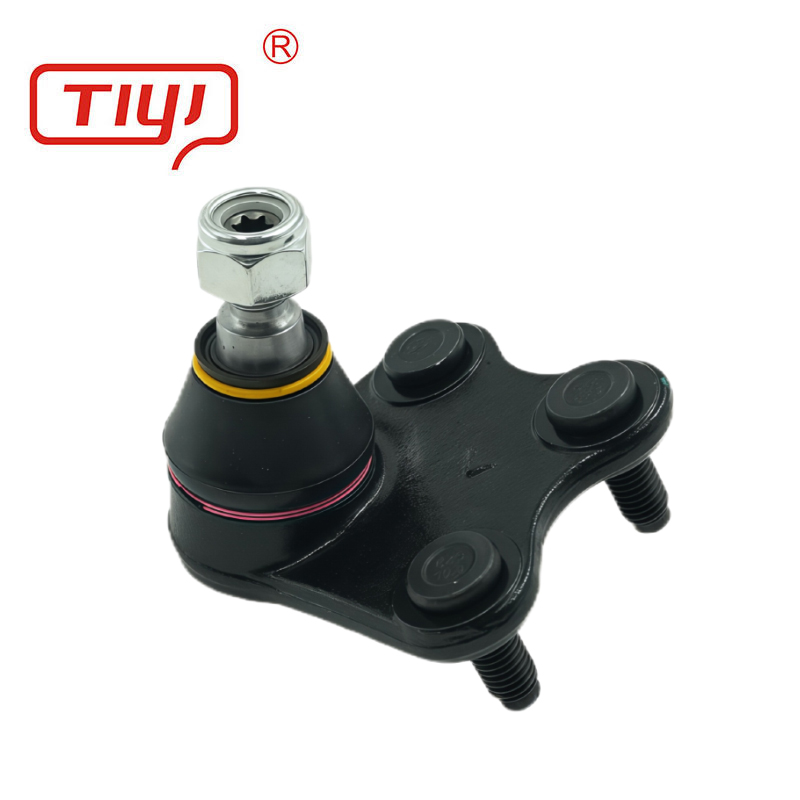
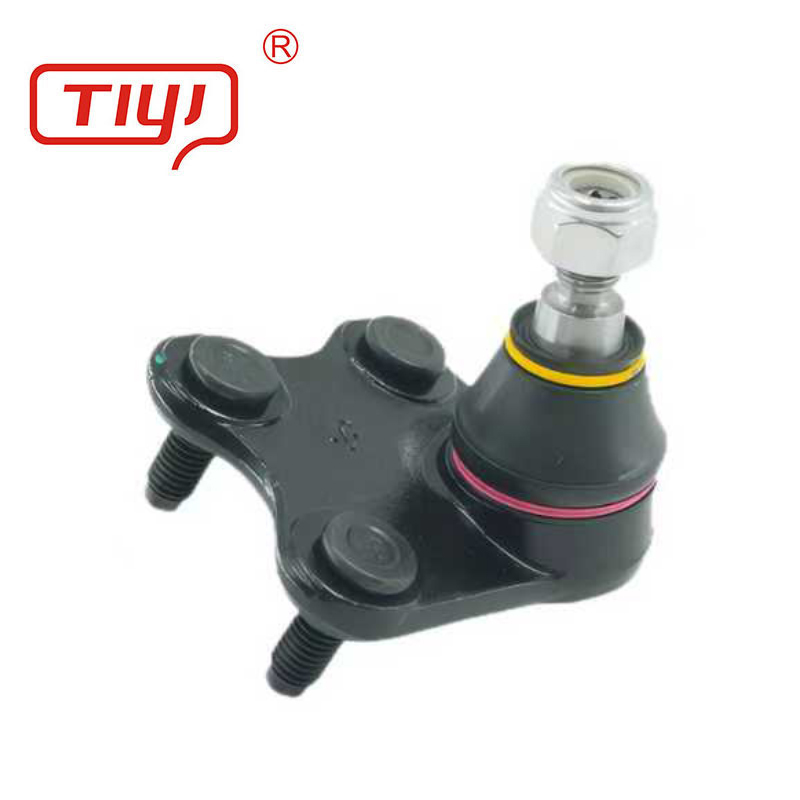
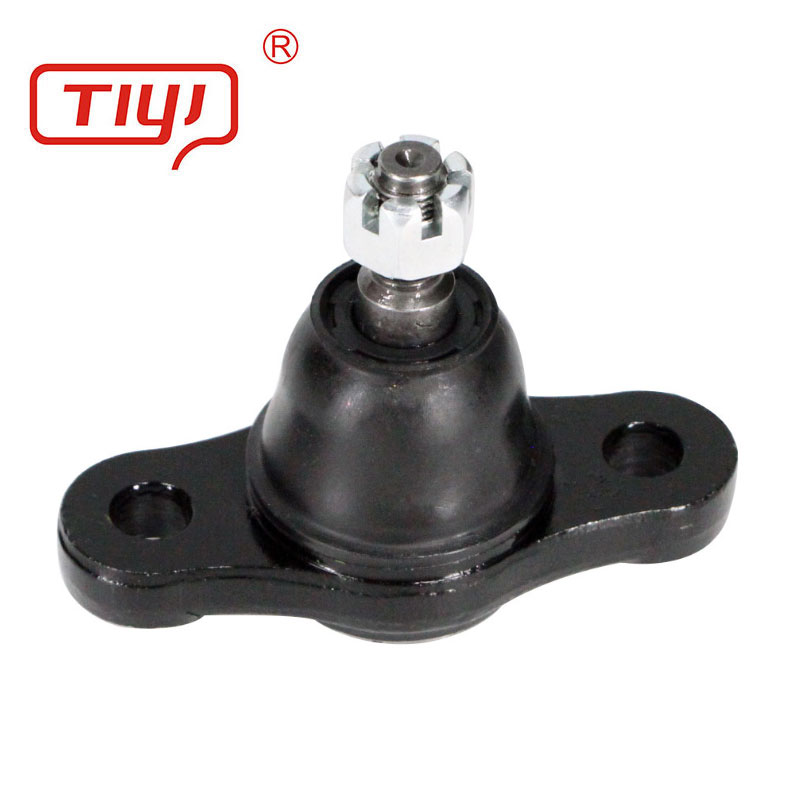
A ball joint is a flexible pivot consisting of a hardened steel ball stud seated inside a lubricated socket housing, designed to carry both load and allow multi-axis movement simultaneously. Think of it as the human hip joint — it must support significant weight while rotating freely in multiple directions without binding or losing positional accuracy.
In a typical front suspension system, each front wheel has at least one ball joint — usually both an upper and a lower ball joint in double-wishbone systems, or a single lower ball joint in MacPherson strut systems. Rear suspensions on independent multi-link designs can have two to four ball joints per wheel.
Ball joints serve two distinct roles depending on their position:
- Load-bearing ball joints carry the vehicle's weight. In MacPherson strut setups, the lower ball joint bears the full suspension load and wears faster than joints in double-wishbone systems where load is distributed across two joints.
- Follower ball joints guide movement but carry minimal vertical load. These typically last longer but still require inspection since their failure affects steering geometry.
Modern sealed ball joints are pre-lubricated and maintenance-free. However, older or performance-oriented designs include grease fittings (Zerk fittings) that should be greased every 15,000 to 30,000 miles to extend service life.
What Are Bushings? Function, Materials, and Types
A bushing is a cylindrical liner — typically made of rubber, polyurethane, or in performance applications, spherical bearing metal — pressed into a suspension or steering component to absorb shock, reduce noise, and maintain pivot geometry. Wherever two metal suspension parts must rotate or flex against each other, a bushing sits between them to prevent metal-to-metal contact.
Bushings are found throughout the suspension and steering system, including:
- Control arm bushings — at the inner pivot points of upper and lower control arms
- Sway bar (stabilizer bar) bushings and end link bushings — securing the anti-roll bar to the subframe and links
- Strut rod bushings — at the rear pivot of tension/compression rods
- Trailing arm bushings — in rear multi-link and semi-trailing arm suspensions
- Subframe bushings — isolating the entire subframe from the chassis
- Steering rack bushings — mounting the steering rack to the subframe
Rubber vs. Polyurethane Bushings: Which Is Better?
Rubber bushings are the OEM standard because they absorb vibration and road noise most effectively, offering a compliant ride at the cost of slightly vague handling at the limit. Polyurethane bushings are harder, more dimensionally stable, and more resistant to oil, ozone, and temperature extremes — delivering sharper steering response and longer service life (often 2–3× longer than rubber) at the cost of increased NVH (Noise, Vibration, Harshness) transmission to the cabin.
Ball Joints vs. Bushings: Core Differences at a Glance
| Feature | Ball Joint | Bushing |
| Primary Function | Multi-axis pivot point (load + rotation) | Single-axis flex, vibration isolation |
| Movement Type | 360° rotation + angular tilt | Limited rotation / flex only |
| Common Materials | Hardened steel ball, nylon/PTFE socket | Rubber, polyurethane, or bronze |
| Failure Symptom | Clunking, loose steering, pull | Squeaking, knocking, vague handling |
| Typical Lifespan | 70,000–150,000 miles | 50,000–120,000 miles (rubber) |
| Safety Risk if Failed | Catastrophic — wheel separation possible | Moderate — alignment and tire wear |
| Replacement Cost (per axle) | $150–$400+ (parts + labor) | $80–$250+ (parts + labor) |
| Requires Alignment After? | Yes — always | Usually yes (control arm bushings) |
Caption: Direct comparison of ball joints and bushings across eight key attributes including function, materials, failure symptoms, lifespan, and replacement cost.
Warning Signs of Worn Ball Joints and Bushings
The earliest warning sign of failing ball joints and bushings is abnormal noise — specifically clunking, squeaking, or knocking sounds from the front suspension when driving over bumps or during low-speed turning. Recognizing the difference between ball joint failure and bushing failure early prevents both safety hazards and cascading damage to tires, alignment, and steering components.
Signs of Worn Ball Joints
- Clunking or thudding noise from the front suspension when hitting potholes, speed bumps, or rough road surfaces — the most reliable early indicator
- Wandering or vague steering — the vehicle drifts subtly without steering input, requiring constant minor corrections
- Steering wheel vibration at highway speeds, especially between 50–70 mph, caused by loose wheel geometry
- Uneven or feathered tire wear — typically on the inner or outer edge of the front tires, indicating the wheel camber angle is changing dynamically as the joint moves excessively
- Visual inspection failure: more than 0.5 mm of axial play or 1.5 mm of radial play measured with a dial indicator indicates a worn ball joint requiring immediate replacement
Signs of Worn Bushings
- Squeaking or creaking from suspension pivot points during slow parking maneuvers or when weight shifts over bumps — rubber drying out is the most common cause
- Knocking or clunking — typically less sharp than a ball joint knock; more of a hollow thud as metal contacts metal through a deteriorated bushing
- Reduced steering sharpness — the vehicle feels "floaty" or imprecise in direction changes, as control arm geometry shifts under load
- Visible cracking or tearing of the rubber bushing material, visible at the inner control arm pivot points during a visual undercarriage inspection
- Brake dive or excessive body roll — worn sway bar bushings and end links allow more body roll than the anti-roll bar was designed to permit
How to Inspect Ball Joints and Bushings: A Step-by-Step Guide
A proper ball joint and bushing inspection requires the vehicle to be safely lifted so the suspension hangs freely — never perform this inspection with the car on its wheels, as load masks joint play.
Ball Joint Inspection
- Lift and support the vehicle on jack stands under the frame (not the control arms) so the suspension drops to full droop.
- Grasp the top and bottom of the tire (12 o'clock and 6 o'clock positions) and rock it firmly in and out. Any perceptible movement indicates ball joint wear — for load-bearing joints, 0 mm play is the acceptable limit on most OEM specifications.
- Grasp the tire at 9 and 3 o'clock positions and rock it laterally. Side-to-side play in this position points to wheel bearing wear rather than ball joints.
- Use a dial indicator for precise measurement: attach to the control arm and position the probe against the ball joint stud. Any reading above 0.5 mm axial or 1.5 mm radial typically requires replacement.
- Inspect the dust boot visually — a torn or missing boot allows contamination and rapidly accelerates internal wear. A torn boot alone is grounds for replacement in most professional inspection standards.
Bushing Inspection
- With the vehicle lifted, use a bright flashlight and mirror to visually inspect all accessible control arm, sway bar, and trailing arm bushings for cracks, tears, or extrusion (rubber squeezing out of the housing).
- Use a pry bar gently applied to the control arm near each bushing location. Movement greater than 3–4 mm in any direction indicates bushing failure.
- Check for oil contamination — oily, swollen, or discolored rubber indicates the bushing has absorbed petroleum products (common near engine or transmission), dramatically accelerating deterioration.
Rubber vs. Polyurethane Bushings: Detailed Comparison
| Property | OEM Rubber Bushings | Polyurethane Bushings |
| Ride Comfort | Excellent (high compliance) | Firm (lower compliance) |
| Handling Precision | Moderate | High |
| NVH Isolation | Excellent | Poor to Moderate |
| Service Life | 50,000–100,000 miles | 100,000–200,000+ miles |
| Oil / Chemical Resistance | Low | High |
| Temperature Range | −40°C to +120°C | −50°C to +150°C |
| Lubrication Required | No | Yes (specific grease) |
| Relative Cost | Low to Medium | Medium to High |
| Best For | Daily drivers, OEM restoration | Performance, track, heavy-duty use |
Caption: Comparison of OEM rubber bushings versus polyurethane bushings across nine performance, durability, and application criteria to help select the right bushing material for your vehicle.
Ball Joint and Bushing Replacement: Cost, Labor, and What to Expect
Replacing ball joints and bushings together during a single suspension service visit saves significant labor cost, since both components require wheel removal, suspension disassembly, and a post-repair alignment — work that overlaps almost entirely.
Typical Replacement Costs
- Ball joint replacement (one corner): $150–$350 parts and labor for most passenger cars. Trucks and SUVs with pressed-in ball joints on heavy-duty control arms range from $300–$600+ per corner.
- Control arm bushing replacement: $80–$200 per control arm if bushings are replaced separately. Pressing out and pressing in new bushings requires a hydraulic press — most shops replace the entire control arm assembly when bushing replacement cost approaches the assembled arm price, which is common on many modern vehicles.
- Complete control arm replacement (arm + ball joint + bushings as an assembly): $200–$500 per corner for most vehicles — often the most economical route when both ball joints and bushings are simultaneously worn.
- Four-wheel alignment after suspension work: add $80–$150 — mandatory after any ball joint or control arm bushing replacement.
Should You Replace Ball Joints and Bushings in Pairs?
Yes — replacing both sides simultaneously is the standard professional recommendation when mileage exceeds 80,000 miles or when the vehicle is more than 8 years old. Components wear at similar rates due to matching mileage and environmental exposure. Replacing only the failed side leaves the opposite side likely to fail within 12–18 months, requiring a repeat of the same labor cost.
Factors That Accelerate Ball Joint and Bushing Wear
Driving conditions and vehicle loading have a greater impact on ball joint and bushing lifespan than mileage alone — a vehicle driven 50,000 miles on rough rural roads may have worse suspension wear than one with 100,000 highway miles.
- Rough or unpaved roads: Pothole impacts deliver shock loads 3–5× greater than normal road loads to ball joints. A single severe pothole impact can deform the ball socket or crack a deteriorated rubber bushing.
- Heavy payloads or towing: Loading a vehicle beyond its rated GVWR increases ball joint loads proportionally. Towing at maximum rated capacity continuously reduces ball joint life by an estimated 20–35% compared to unloaded use.
- Lifted suspensions: Suspension lift kits increase CV axle and ball joint operating angles beyond their design range, dramatically accelerating wear — often reducing ball joint life to 30,000–50,000 miles in heavily lifted trucks.
- Neglected alignment: Misalignment creates uneven side-loading on ball joints and abnormal flex stress on bushings. A vehicle with just 0.5° of excess camber can accelerate inner ball joint wear by up to 40%.
- Torn dust boots: Once the protective boot on a ball joint or bushing is torn, dirt, grit, and water ingress begins immediately. Contaminated grease in a ball joint socket abrades the socket liner, reducing remaining life from years to months.
- Salt and corrosion environments: Road salt in winter climates penetrates between ball joint housings and control arms, seizing components and accelerating external corrosion that eventually compromises the joint housing itself.
The Consequence of Ignoring Failed Ball Joints: A Safety Perspective
A completely failed ball joint — one where the stud separates from the socket — causes immediate and total loss of steering and wheel control, which the National Highway Traffic Safety Administration (NHTSA) classifies as a catastrophic safety failure. When a lower ball joint separates, the wheel collapses inward (negative camber failure), the spindle drops, and the vehicle has no steering or braking authority on that corner.
NHTSA data shows that suspension component failures — including ball joints — account for approximately 5,000 motor vehicle crashes annually in the United States. Unlike bushing failure, which degrades performance gradually, ball joint failure can be sudden and without further warning after the initial clunking stage.
The practical safety rule: any measurable play in a load-bearing ball joint is grounds for immediate replacement. There is no acceptable "monitor and drive" threshold for worn load-bearing ball joints.
Frequently Asked Questions About Ball Joints and Bushings
Q1: Can I drive with worn ball joints or bushings?
Worn bushings with no play — just noise or vagueness — can be monitored short-term while scheduling repair. Worn ball joints with measurable play should not be driven on, as failure can be sudden. Any ball joint with a torn boot or visible looseness must be replaced immediately. Do not drive on a ball joint that exhibits more than 1.5 mm of radial play under measurement.
Q2: How long does it take to replace ball joints and bushings?
A single ball joint replacement typically takes 1–2 hours of shop labor. Replacing all four control arm bushings on both sides takes 3–5 hours depending on whether the entire control arm is replaced or bushings are pressed individually. A full front suspension refresh (both ball joints, all control arm bushings, sway bar links and bushings) is typically a 5–8 hour job including alignment time.
Q3: What noise do bad ball joints and bushings make?
Ball joints typically produce a sharp metallic clunk or knock, most pronounced when driving over bumps or during slow turns in parking lots. Bushings more often squeak or creak during slow maneuvers, weight transfer, or when moving the steering wheel at a standstill. A hollow "clop-clop" over rough pavement tends to indicate bushing wear, while a sharp single "clunk" on each bump is more characteristic of ball joint play.
Q4: Do ball joints and bushings need to be replaced at the same time?
Not necessarily at the same time, but if both are worn, combining the repair in a single visit makes strong economic sense. Since both repairs require suspension disassembly and a post-repair alignment, performing them together eliminates duplicate labor charges. If only one is worn, replace only what is needed — but plan for the other to follow within the same service interval, especially on vehicles over 80,000 miles.
Q5: Are aftermarket ball joints and bushings as good as OEM parts?
Quality varies significantly among aftermarket suppliers. Premium aftermarket ball joints with greaseable Zerk fittings, forged steel construction, and PTFE-lined sockets often outlast sealed OEM joints when properly maintained. Budget aftermarket parts — particularly those with no identifiable quality certification — frequently fail in 30,000–50,000 miles. For safety-critical components like ball joints, prioritize parts that meet or exceed OEM load ratings and include a warranty of at least 3 years or 50,000 miles.
Q6: Will replacing ball joints and bushings improve ride quality?
Yes — significantly, especially on high-mileage vehicles. Worn bushings allow the suspension geometry to shift under load, which the driver perceives as vagueness, float, and imprecise steering. Fresh bushings restore the suspension to its designed geometry. New ball joints eliminate the play that causes steering wander and shimmy. Many drivers describe a full suspension refresh including ball joints and bushings as making the vehicle feel like new — often with a more pronounced improvement than new shock absorbers alone.
Conclusion: Prioritizing Ball Joint and Bushing Health Is Non-Negotiable
Ball joints and bushings work as a system — when either degrades, the other is forced to compensate, accelerating wear across the entire suspension. Treating them as separate, independent concerns leads to incomplete repairs, repeat alignments, and continued tire wear.
The practical takeaway: inspect ball joints and bushings at every tire rotation (every 5,000–7,500 miles), replace worn components in axle pairs, always follow suspension work with a four-wheel alignment, and choose component quality that matches your vehicle's use case — OEM rubber for comfort-oriented daily drivers, polyurethane for performance or heavy-duty applications.
A complete front suspension refresh — including both ball joints and bushings — typically costs $600–$1,200 for most passenger vehicles and represents one of the highest-impact maintenance investments available for restoring both safety and driving dynamics on any vehicle beyond 80,000 miles.